


My private Italy: Falling in love with Caravaggio in Rome
The Renaissance, Italy: the pinnacle of pictorial art. Michelangelo, Leonardo, Raphael—the artists who best represent this peak. After them, one might say that no one could ever reach such heights of perfection; no artist could invent something both new and immortal.
I, too, in my personal journey through Italian art, came to know the great masters through their universally famous works: The Last Judgment, The Last Supper, The School of Athens. Then, a few years later, I walked into a little-known church in Rome, San Luigi dei Francesi, and there I fell hopelessly in love. Yes, because in this artist’s work I saw life—real, everyday life. This artist is Michelangelo Merisi, but we all know him by the nickname given to him after his birthplace: Caravaggio.
Yes, it is true, I am hopelessly in love with Caravaggio. When I look at one of his paintings, I do not see fiction: I smell the dust and feel the warmth of the skin. Before him, the art world was a theater of elegant poses and pastel colors; then he arrived and tore down the curtain. He decided that dirty fingernails, strained muscles, and bruised fruit deserved eternity just as much as an angel. Before him, art was a beautiful dream, a polite perfection to look upon with awe. He turned off all the superfluous lights and left only one burning—violent and from the side, as if coming from a door left ajar in a Roman alleyway.
This is what makes my heart beat faster: Caravaggio did not try to beautify the world, he chose to love it for what it is. He took his friends, the outcasts, even the prostitutes he frequented, and made them eternal, with their black nails, their wrinkles of exhaustion, their ragged clothes. A revolutionary theological statement: God’s Grace descends among the lowest, into the mud of daily reality, just as Jesus had done. This choice made sacred art accessible and deeply empathetic for the people. No one, before his tormented genius, had understood that the sacred does not reside in gold or in clouds, but in the flesh that trembles under a ray of sunlight. Caravaggio broke down the wall between the divine and the human. While his contemporaries painted ethereal saints and nobles, he brought the reality of Rome’s backstreets into churches.
But the real magic that takes your breath away, is how he handles shadow. Caravaggio does not paint light; he invents it. He uses it like a scalpel to cut through the darkness, a sudden beam that decides what we must see and what must remain in mystery. Before him, light was everywhere and nowhere; with him, it becomes an absolute protagonist, a spotlight that hits the naked truth, leaving everything else in the silence of black. A light that does not forgive, but makes everything terribly, wonderfully real.
Before Caravaggio, light served to illuminate objects uniformly or ideally. He transforms it into a narrative and psychological tool. This technique does not just give volume to bodies, but acts like a theatrical spotlight: it decides what the viewer must see and what must remain in mystery, anticipating the language of cinema and photography by centuries.
Rome, with its violent contrasts, cardinal splendor, and street poverty, was the ideal stage for transforming sacred art into a raw, tangible human experience. Among the alleys of the historic centre, perhaps his most revolutionary painting cycle awaits to be discovered by curious visitors.
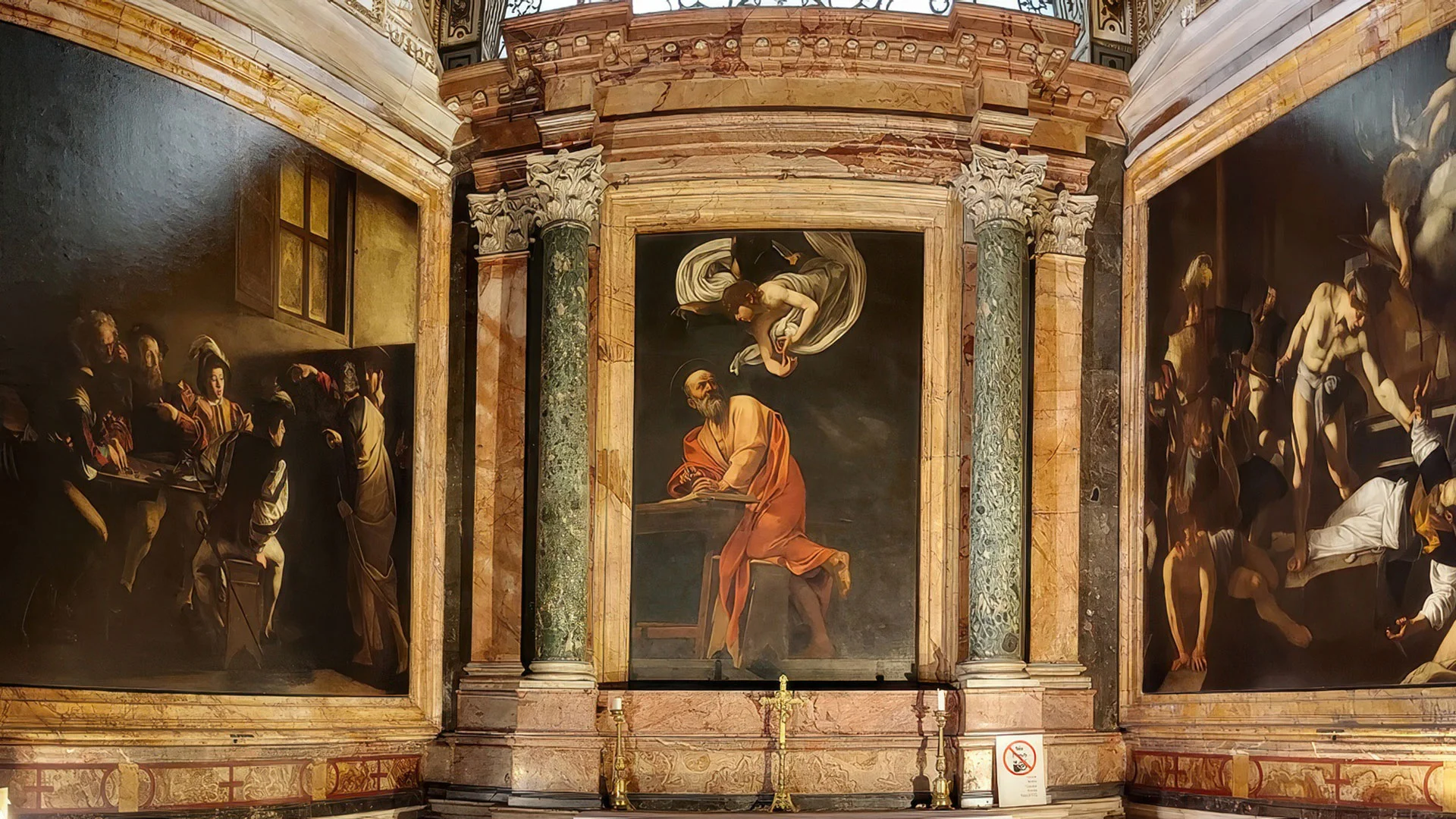
Inside the Church of San Luigi dei Francesi, in the far left corner, the Contarelli Chapel represents the artist’s first great public success. Commissioned in 1599 to honor Cardinal Mathieu Cointrel, the cycle comprises three monumental canvases dedicated to the Apostle Matthew.

The Calling of Saint Matthew (Left wall)
Set in a dark room reminiscent of a Roman tavern contemporary to the artist. Christ, half-hidden in the shadow, calls the tax collector Matthew to follow him, with a gesture that recalls Michelangelo’s Creation of Adam in the Sistine Chapel. Matthew, astonished, reacts by pointing to himself, as if to ask: “Me?”. What a natural pose, in which we can all recognise ourselves. The men at the table are dressed in seventeenth-century clothes, modern for Caravaggio’s time. This serves to say that God’s call can happen here and now, in the present of the viewer.
Light, the symbol of divine grace, is the true protagonist. It does not come from the window (which remains opaque), but from an invisible source at the top right, behind the figure of Christ, following the outstretched arm of Christ. It is a divine light that pierces the darkness and guides the viewer’s eye toward Matthew’s face.

Saint Matthew and the Angel (Altarpiece)
The version visible today is actually the second one. The first was rejected by the patrons because the saint appeared too coarse, a semi-illiterate peasant physically guided by an angel. In the final version, Matthew looks more noble, though he maintains a precarious dynamism, balancing on a stool. The altarpiece shows the saint writing the Gospel, inspired by an angel descending from above.
The saint is caught in a moment of unstable dynamism: he rests with one knee on a stool that projects dangerously toward the viewer, creating an incredible effect of depth. The angel descends from above, wrapped in a vortex of white drapery, and counts the points of the discourse on his fingers to help the saint write. Unlike the first version, here Matthew is a scholar, but he maintains a human, palpable physicality.

The Martyrdom of Saint Matthew (Right wall)
A chaotic scene, almost a breaking news snapshot, depicting the final episode of the saint’s life, assassinated while celebrating mass. The saint is attacked at the altar; chaos reigns around him. A dramatic, convulsive composition portraying the murder of the saint.
It is the most complex canvas in terms of composition. At the center is the semi-nude executioner pinning the saint’s hand to the ground. All around is a centrifugal movement of people fleeing in terror. From above, an angel leans out from a cloud to hand Matthew the palm branch, symbol of his future glory. In the background on the left, among the crowd, a bearded man watches the scene with a sorrowful expression: it is the face of Caravaggio, who chooses to “witness” the martyrdom.
In these canvases, Caravaggio eliminates complex architectural backdrops to focus solely on the human body and color. The transition from total darkness to violent light does not just create spectacle, but symbolises the dialectic between sin and salvation. He avoids the forced poses and artificial colors of the artists before him to impose a raw realism. In his works, we do not see a story unfolding, but the culminating instant of an action (the exact moment Jesus points at Matthew). This sense of urgency and “presence” makes his paintings vivid and contemporary even today.
There is a “before Caravaggio” and an “after Caravaggio”. From then on, nothing would ever be the same, and all painters would have to reckon with him.
Ciao da Vitor