


My private Italy: The Palio, dreaming twice a year in Siena

The Palio di Siena is a horse race run twice a year, on 2 July and 16 August, around Piazza del Campo. Ten of the city’s seventeen contrade compete, their jockeys riding bareback for three laps, and the prize is a painted silk banner, the drappellone. That is what the guidebooks say. For the Senesi, it is something else entirely.
The colours, sounds and emotions of the Palio
To me, as well as to many Italians who love Siena and visit the city often, the Palio is a combination of colours, sounds and emotions.
The colours: from the yellow ochre of the earth spread over the stones of Piazza del Campo, to the flags and the scarves of the contradaioli, the people of the contrade.
The sounds: the toll of the great bell rolling down from the Torre del Mangia; the songs thrown as a challenge from one group to another, the same tune with different words, almost always ending with “by force and by love, you must respect us”; the silver trumpets beside the Carroccio, the ox-drawn cart carrying the Palio itself, the “drappellone“, a silk banner painted each time by a different artist with an image of the Virgin; the firecracker that bursts when the jockeys come out of the Entrone, the entrance to the Piazza from the courtyard of the Palazzo Pubblico; the hooves pounding the earth; the strangled cry of the contradaioli.
And the emotions. The emotions of the Senesi, the ones a visitor who is not from Siena can only guess at, but will never truly live.
I have taken private tours to Siena many times, in every season, often together with the Val d’Orcia and its hot springs, and I have seen both Palios: Provenzano in July and the Assunta in August. But the air of the Palio, you can almost grab it all year round. Sometimes, even on a January night, as you turn the corner of a street in the centre, the echo of a song rises, faint at first, then stronger, until all the voices come together in an insult to the enemy contrada or in the memory of a victory.
How the Palio was born
The Palio is older than the race you see today in the Campo. Its name comes from the Latin pallium, the precious cloth given to the winner, and its heart is devotion to the Virgin. In 1260, before the battle of Montaperti against Florence, Siena consecrated itself to Mary. The Senesi won, and the city has never forgotten.
For centuries, on the feast of the Assumption, horses raced alla lunga, through the streets, from outside the walls to the Cathedral. The contrade, meanwhile, entertained the city in Piazza del Campo with games of their own: buffalo races, the bufalate, and later donkey races.
In the seventeenth century the horses moved into the Campo, racing alla tonda, around the square. In 1656 the minucipality decided to run a Palio every year on 2 July, in honour of the Madonna di Provenzano, a humble terracotta image of the Virgin believed to work miracles. From 1701 the contrade raced around the Campo in August too. In 1729 a decree by Violante of Bavaria, governor of the city, fixed the borders of the seventeen contrade, the same ones you walk through today.
Since then, the rules have changed little. The passion, not at all.
Two Palios: Provenzano on 2 July, the Assunta on 16 August
Even in winter the Palio is in the air, but it lives its real days in summer. Siena runs it twice: on 2 July in honour of the Madonna di Provenzano, and on 16 August for the Assumption of the Virgin, the Assunta. Each race has its own banner, its own winner and its own four days of celebration.
Everything begins on a late June morning. The Senesi looking out of their windows watch the workers spreading the earth, brought out of the municipal warehouse, over the stone slabs of the Campo, slowly, shovelful by shovelful. The news runs through the city, and a trace of yellow on someone’s shoes tells you that he could not resist walking once more around the ring of Piazza del Campo.
The 17 contrade, and the 10 that run
Siena is divided into seventeen contrade, each with its own name, emblem, colours, church and museum: Aquila (Eagle), Bruco (Caterpillar), Chiocciola (Snail), Civetta (Owl), Drago (Dragon), Giraffa (Giraffe), Istrice (Porcupine), Leocorno (Unicorn), Lupa (She-wolf), Nicchio (Shell), Oca (Goose), Onda (Wave), Pantera (Panther), Selva (Forest), Tartuca (Tortoise), Torre (Tower) and Valdimontone (Ram).
But only ten run each Palio. Seven take part by right, because they did not run the same Palio the year before; the other three are drawn by lot among the remaining ten. The seven left out will run by right the following year.
The Tratta, the Jockey’s Mass and the Blessing of the Horse
Three days before the race, on 29 June for the Palio of July and on 13 August for the Assunta, the tratta takes place in the Piazza. The horses are brought for a veterinary check, the captains of the ten contrade choose the ten best suited, and finally a draw assigns a horse to each contrada. Here fate speaks first: a contrada cannot choose its horse, only its jockey.
Six trial runs, the prove, follow over the next three days, and the contrade can still change their jockey until the morning of the race, when the names are finally signed.
The day of the Palio begins at dawn with the Messa del Fantino, the jockeys’ Mass, celebrated in the Piazza: the Archbishop of Siena asks God to protect the jockeys. Then comes the last trial, called the provaccia, the “bad trial”, because at the last moment nobody wants to take risks, and the contradaioli go back to their contrade.
In the early afternoon, the horse is blessed in the contrada’s church. “Go, and come back a winner” the priest says, in a tense silence, with the whole contrada gathered around. After that, the comparse, the young people who represent the contrada in the parade, move towards the centre of the city.
The “Corteo Storico”, the entry into the Campo and the “Mossa”
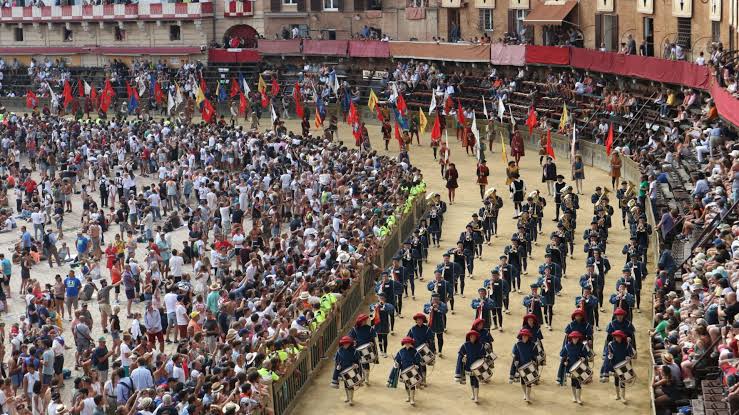
Finally, here we are. The charge of a squadron of mounted Carabinieri vanishes in a flash of drawn swords, and soon the great bell of the Torre del Mangia begins to toll, a hollow sound that wraps the people in the Piazza and then slides away to the edges of the town. Slow and solemn, the Corteo Storico enters the Campo in Renaissance costume, in memory of the ancient freedom of the Republic of Siena. At the end of the parade comes the Carroccio, with the drappellone that everyone wants.
Then the ten jockeys ride out of the Entrone, take the nerbo, the whip, show it at once to the crowd, and set off for the start, the Mossa. Once again fate is sovereign: a draw fixes the order in which the horses enter between the canapi, the two starting ropes, and decides who will have a good place and who a bad one, who will be right beside you, enemy or friend. Nine horses line up between the ropes; the tenth, the rincorsa, waits behind them, and the race starts only when it decides to charge.
And then, the “Mossa”, time and time again. The horses are nervous between the ropes, but much of that nervousness comes from the jockeys, who have not yet “settled down”, and the mossiere, the starter, often has to call all the horses out and back in again many times before the right start. It can take minutes; sometimes it takes much longer.
Three laps around the Campo, and only one winner
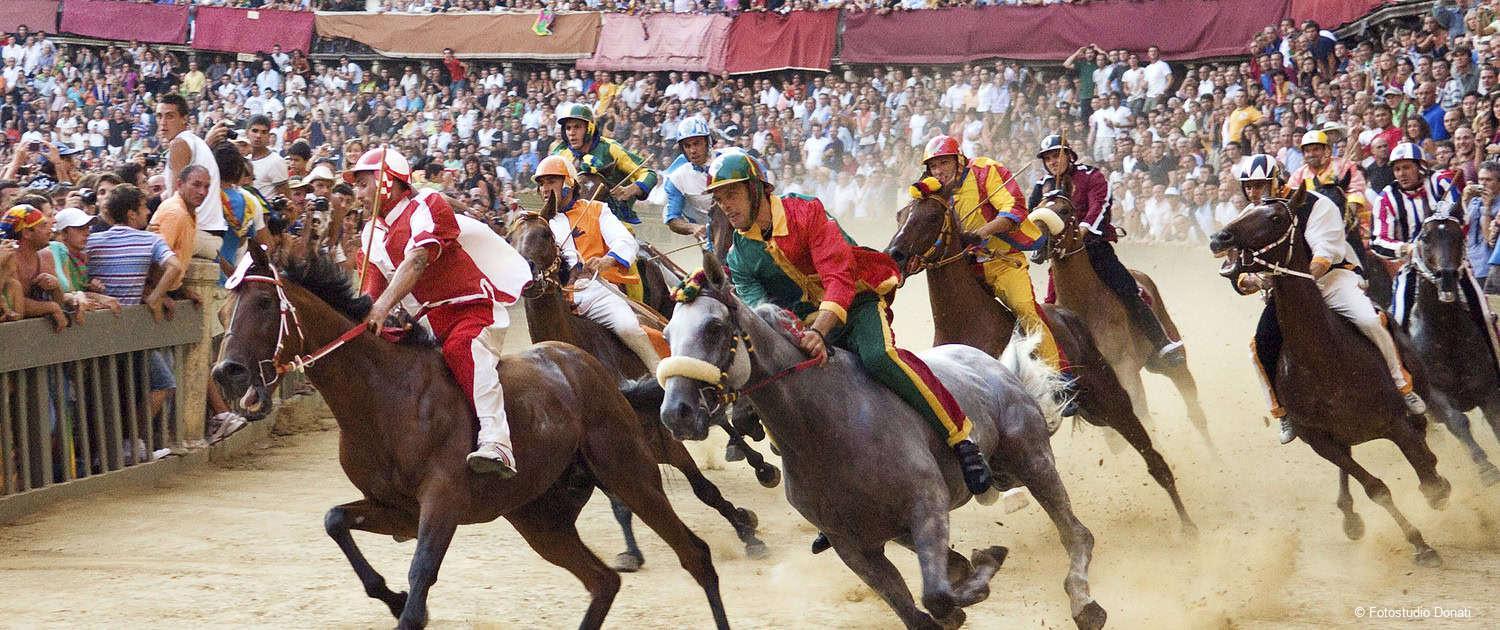
Then the rope drops, and the horses are off. All together to the curve of San Martino, the most feared, then down and up again towards the curve of the Casato. Once, twice, three times. Little more than a minute.
And even if the jockey falls, it is not decisive: the horse without its rider, the cavallo scosso, usually keeps running, and it can cross the line first and win the Palio for its contrada.
One contrada wins, all the others lose: here, coming second makes no sense; it is no honour. The honour belongs only to the winner, who carries the drappellone through the city in triumph and unleashes terrible teasing on the enemy.
In Siena, the dream comes true twice a year, and it is one no one will ever forget.
P.S. By the way, you can see the Palio di Siena in the opening scenes of the James Bond film Quantum of Solace (2008). But pay attention: the first scene, with the camera coming in from the water, and the car chase through the tunnels that follows are not near Siena, as they seem: that is the upper Lake Garda.
Ciao da Marcello
Read other articles about Tuscany in our Blog:
My private Italy: in Tuscany, eat like a Toscano
My Private Italy: Three Places in Florence for the travellers who think they’ve seen it all
My private Italy: Why Florence is the true cradle of modern perfumery