


My Private Italy: Three Places in Rome for the travellers who think they’ve seen it all
Have you ever visited Rome? Me, I can’t even remember how many times I have been back.
After a while, a strange thing happens to frequent travelers like me: you stop registering the grandeur. The Colosseum becomes just a familiar backdrop you walk past on your way to the bus. The Pantheon? A blurred shape in front of you while you enjoy a gelato, because its features are already deeply engraved in your brain.
And yet, Rome keeps drawing me back. Why? Because the Eternal City has a superpower: it always knows how to surprise you. The real magic begins when you step off the standard tourist checklist and start to explore. Marvellous pieces of art and architecture have always been tucked away behind an unremarkable door, marked by a modest sign, and guarded by an entrance fee so cheap it leads you to believe nothing special is there.
So, let’s leave the crowded squares behind and step through these three secret portals into the world of Rome’s visual masters.
Michelangelo’s Moses: The Impossible Move at San Pietro in Vincoli

Our first stop sits on the Esquiline Hill, literally a five-minute walk from the Colosseum. Every Roman knows San Pietro in Vincoli (Saint Peter in Chains) exists, yet very few locals or tourists visit regularly.
While the church takes its name from the 15-century-old chains that bound St. Peter—kept beneath the main altar—the real reason you must cross this threshold is one of the most devastating masterpieces Michelangelo ever created: The Moses.
Originally intended for a colossal, 40-sculpture tomb for Pope Julius II, decades of interruptions left the project downsized. What was installed here in 1545 was only a fraction of the grand vision. But Moses is more than enough.
The Anatomy of Stone
When you stand in front of the statue, the sheer monumental scale hits you instantly. Michelangelo captured a man in the exact instant before a life-altering decision. Look closely, and you will see details that seem impossible for stone: the hand grips the tablets with pulsing tension, the other hand restrains his beard as if physically holding back an outburst, and the veins in his neck are visibly raised (do you remember the veins on David’s hand in Florence?).
The 2018 Discovery: Rotating Finished Marble
But, beyond its appearance, the real marvel lies in how the statue was created. For centuries, art historians believed this posture was planned from day one. However, a 2018 deep scientific investigation proved something extraordinary: Michelangelo literally rotated the finished statue nearly 30 years after creating it. First, he realized the church’s natural light came from a window on the right: in the original forward-facing pose, half of Moses’ face was left in gloomy shadow. But also, amid the religious turmoil of the Reformation, Michelangelo wanted Moses to turn his back on the altar—symbolizing a rejection of papal corruption—and face the divine light.
Modifying a finished marble statue is theoretically impossible. But, nothing is impossible to a genius. Michelangelo “shrinked” the statue within the existing block, cleverly altering the head, the throne, and the left foot to carve out a completely new posture.
The Mystery of the Horns
Why on earth does Moses have two small horns on his head? The answer lies in a legendary translation error. Michelangelo used the Vulgata (the Latin Bible translated by Saint Jerome in the 4th century AD). The Book of Exodus describes Moses coming down from Mount Sinai, his face glowing from speaking with God.
The original Hebrew verb was karan (“to shine”). However, the Hebrew noun for a ray of light is almost identical to the word for a horn: keren. Saint Jerome mistook the two, translating it as “his face was horned”. Michelangelo actually knew about the error, but kept the horns so his audience would instantly recognize the prophet.
Standing in awe before this giant, I cannot help but pronounce the famous words “Perchè non parli?”. They say Michelangelo was so stunned by how alive the sculpture looked that he struck its knee with a hammer, shouting: “Why don’t you speak?!”. A myth, perhaps, but one you will completely understand the moment you look into Moses’ marble eyes.
Raphael’s Galatea: The Performance of Magnificence at Villa Farnesina

Our next spot takes us to Trastevere, which means most visitors will walk past the street it is on at least once – likely in the evening on the way to dinner, long after its doors have closed.
Villa Farnesina was built in the early 16th century for Agostino Chigi, a Sienese banker. Chigi became the most powerful financier in Europe, funding popes and wars alike. But Chigi did not build this villa to live in; he built it to entertain, and his parties were legendary.
During his lavish banquets on the banks of the Tiber River, Chigi would order his servants to throw the solid silver dishes into the river after every single course. It was a theatrical display to show that such immense wealth was beneath his concern. But, here’s the trick. Chigi had secretly installed nets just beneath the water’s surface to retrieve all the silver quietly the next morning!
Raphael’s Painted Joy
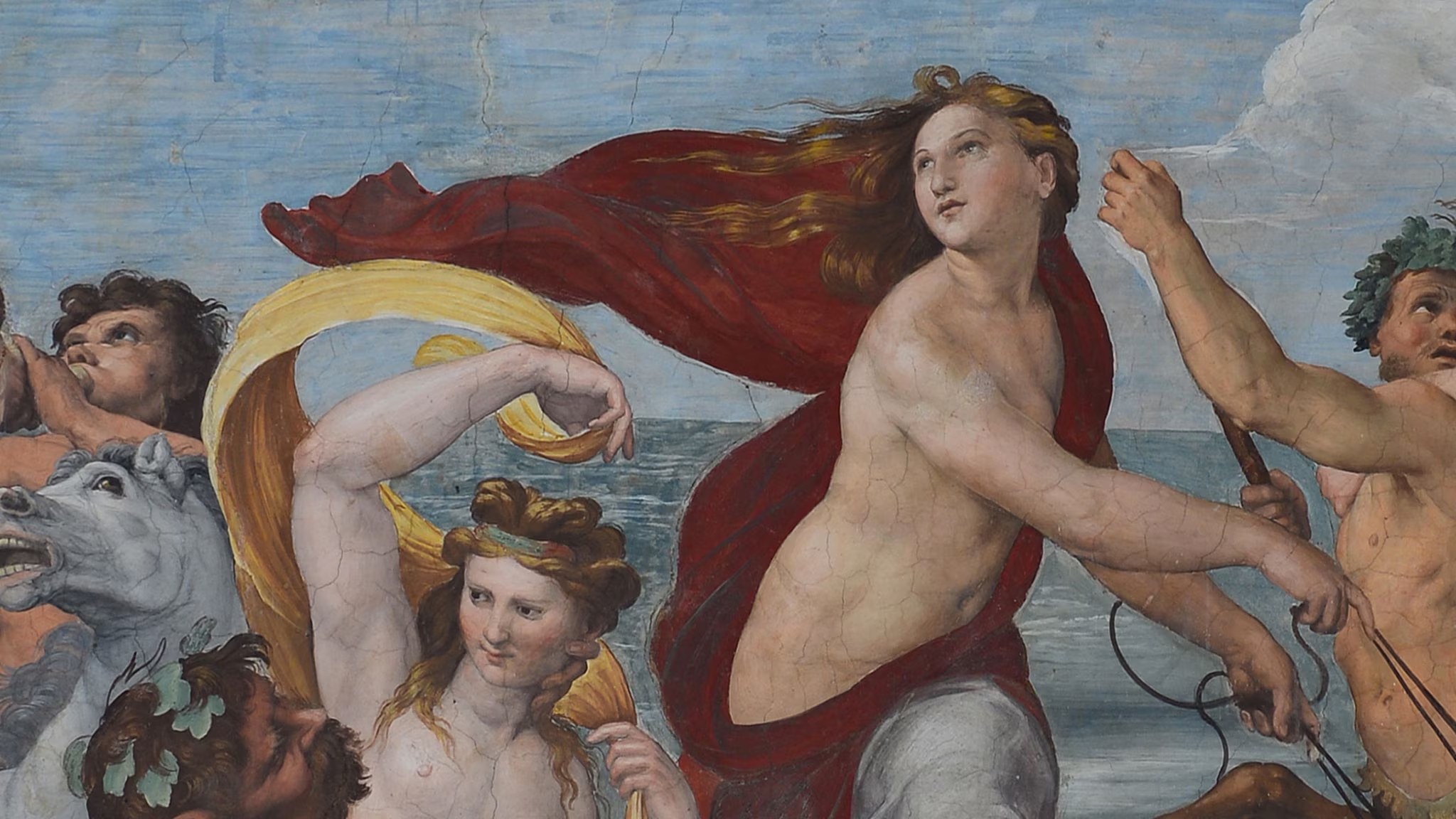
To decorate his garden loggia, Chigi hired the master himself: Raphael. The result was the Triumph of Galatea, one of the most joyful, radiant images in the entire city of Rome.
The fresco depicts a sea nymph on a shell chariot pulled by dolphins, surrounded by swirling tritons and cupids. At the center is Galatea’s face—tilted upward, guarded by nothing but pure bliss. The blues, reds, and golds are so vivid they look freshly painted. When asked who his model was, Raphael famously replied that he did not paint Galatea from a real person, but from a pure idea of beauty that he carried in his mind.
Unlike the crowded rooms of the Vatican Museums, at Villa Farnesina you can often have this masterpiece entirely to yourself. You can stand close enough to see Raphael’s individual brushstrokes, face-to-face with the Maestro.
Before you leave, another masterpiece: head upstairs to the Hall of Perspectives, painted by Baldassarre Peruzzi. Peruzzi used advanced Renaissance trompe-l’œil geometry to turn solid, flat walls into open marble colonnades looking out over 16th-century Rome. The illusion is so perfect that you will find yourself walking directly toward the painted landscape, fully convinced you are about to step out onto a balcony, before realizing the wall is completely solid. Don’t be embarrassed when it happens to you; it happened to me the first time, too.
Borromini’s Corridor: The Great Baroque Deception at Palazzo Spada

Our final destination, the Borromini Corridor at Palazzo Spada, is probably the most purely pleasurable thing to look at in all of Rome.
To understand this masterpiece, you first need to understand its creator: Francesco Borromini. Unlike his bitter rival Bernini—who was outgoing, wealthy, and loved by Popes—Borromini was a melancholic, proud, and deeply troubled perfectionist. His intense anxiety and professional frustrations eventually led him to tragically take his own life right here in Rome. Yet, his inner turmoil birthed some of the most mathematically brilliant architecture the world has ever seen.
You will find Palazzo Spada just a few steps away from the bustling square of Campo de’ Fiori. The building welcomes you with a facade absolutely covered in stucco relief—statues, garlands, and Roman emperors stacked on decorative excess.
Go straight through the entrance, cross the inner courtyard, and look for the colonnaded passageway on the far side. What you will see is a grand, elegant gallery stretching perhaps 30 meters (nearly 100 feet) away from you. The columns recede in perfect perspective, leading your eyes toward a sunlit garden at the far end where a life-sized marble statue stands.
It is beautiful, serene, and spatially convincing in every single detail. Ready to walk the distance to touch the statue?
30 Meters That Don’t Exist
Stop right there! You are being completely deceived.
In reality, the corridor is only 8.5 meters (28 feet) long. And that “life-sized” marble statue at the end? It is barely 60 centimeters (2 feet) tall.
Borromini designed this optical illusion around 1652 with the help of a mathematician, and the engineering of the deception is absolute perfection: the columns rapidly shrink in size as they recede into the distance, the floor slopes gently upward toward the exit, the ceiling angles sharply downward, the walls converge inward rather than running parallel.
Here is the most incredible part: even when you know the trick, it still works. You can stand at the entrance, fully aware of the math, yet your brain simply refuses the correction. Your eyes will continue to see 30 meters of grand architectural space that simply is not there. It is the ultimate testament to Borromini’s genius, a physical proof of how architecture can manipulate human perception.
Indeed, these three architectural masterpieces serve as definitive proof that Rome’s cultural wealth extends far beyond the iconic, crowded landmarks. Beyond the massive postcard monuments lies a subterranean network of genius, an entire alternative world waiting to be uncovered just blocks away from the main tourist hubs.
You’ve come all this way, take a detour, push the door open and go in. A city of wonders is waiting for you.
Ciao da Marcello